Folding@Home

Folding@Home
What is Folding@Home?
Folding@Home uses volunteers' computing power to simulate protein folding for research into diseases such as cancer and Alzheimer's. Proteins are tiny molecular machines: their shape and the way they move help determine how our cells work. When proteins misfold, clump together or function incorrectly, the effects can contribute to disease. Folding@Home studies how proteins fold and move, not just what their final structures look like.
Simulating that motion requires enormous numbers of small calculations. By sharing the work across volunteers' computers, researchers can explore many possible paths and rare changes that would be difficult to study on one machine. These models can help explain disease mechanisms and identify ways for potential medicines to interact with proteins. Each machine works on simulation tasks called work units. Completing these earns points, which help me keep track of my contribution.
The science is run by an international research consortium, with current labs at institutions including the University of Pennsylvania, Memorial Sloan Kettering, the Flatiron Institute, the University of Edinburgh and KTH Royal Institute of Technology. These labs design and analyse simulations, then follow up predictions in their own laboratories or with experimental collaborators. Folding@Home reports over 200 peer-reviewed papers, covering protein behaviour, disease research and methods that support drug discovery.
Why it's important to me
I've lost close friends and family to these diseases. Two family friends in particular are part of why this work matters to me.
Colin and his wife, Jacqueline, welcomed us as neighbours when we moved into our first home in the UK. We helped each other and invited each other to Christmas parties. Colin was warm and loving, and their kindness was part of our life here. He had Alzheimer's and passed away in 2023. I miss him.
Another family friend was the mother of a friend I went to Sunday school with. I remember visiting their house: a warm, vibrant family home. Her husband, a lecturer and scientist, introduced me to the Fourier series, even though I didn't understand much of it at the time. She passed away in 2024, after years of living with stomach cancer. I want to remember that warmth and the family connections we shared.
Losing them has stayed with me. I want to help in a way that I'm capable of, as much as I can. Donating computing power is one concrete way I can support research. My hope is that research like this will help reduce suffering, so fewer people and families have to experience the pain these diseases bring.
My contribution
I run Folding@Home across a small fleet of my computers. With this setup, I earn around 5-6 million points per day.

A snapshot of the fleet.
Not every machine runs continuously. I pause some of them, especially the CPU-only machines, because I haven't found CPU folding very efficient on this setup. The non-CUDA GPUs also struggle: they aren't using the HIP implementation, for various reasons beyond my control. Even so, they're efficient enough and contribute enough work to make me happy, so I keep them folding.
The fleet includes:
cachyos-v1: My main computer, with an AMD Ryzen 9 5950X and an NVIDIA GeForce RTX 5060 Ti 8GB.march: An old Mac running Arch (hence the name), with an Intel Core i5-4570R and integrated graphics. Its CPU folding performance is poor and the iGPU can't be used for folding.Omen: A HP laptop with an AMD Ryzen 7 5800H, an NVIDIA GeForce RTX 3060 Mobile 6GB, and AMD Radeon Vega integrated graphics.TrustyServer: My main server, with an AMD Ryzen 7 5700X3D, an AMD Radeon RX 9060 XT 16GB, and an AMD Radeon RX 7600 XT 16GB. It's also a useful machine for running AI locally.ubuntu3: Four ARM Neoverse-N1 cores on Oracle's free compute tier. It's free, so it might as well support a good cause.
The heat...
The biggest challenge with these machines is the heat. As I write this in early November 2026, they produce enough that I don't need to heat my rooms with gas. On warmer days, I use a fan to blow heat out of my room and into other rooms in the house. Despite that, my room is still around 4°C (7.2°F) warmer than the others.
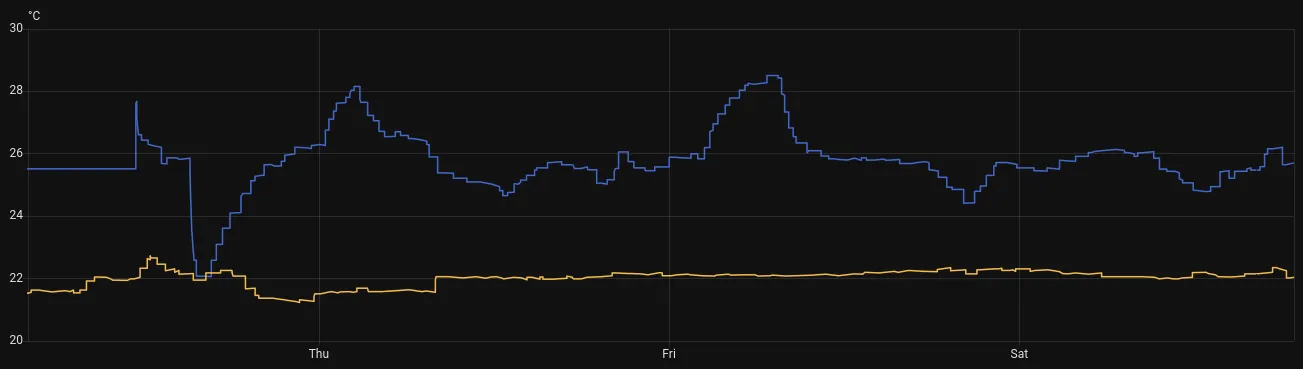
My room (blue) and living room (yellow).
Ranking
I've contributed computing resources since the start of the COVID-19 pandemic, beginning with a less powerful computer. My current Folding@Home account is rijn.dev.
On 7 November 2026, the public statistics showed:
- Overall rank: 27,679 out of 3,021,483 donors, placing me in approximately the top 0.92% by total points. This was checked at 19:15 GMT in the donor statistics.
- November month-to-date rank: 737, based on points earned during November 2026. This was checked at 19:17 GMT in the monthly donor standings. This month-to-date position is separate from my overall rank.
I'm proud of this contribution, and I truly want to keep supporting the cause.