Lagrange Interpolation and Secret Sharing
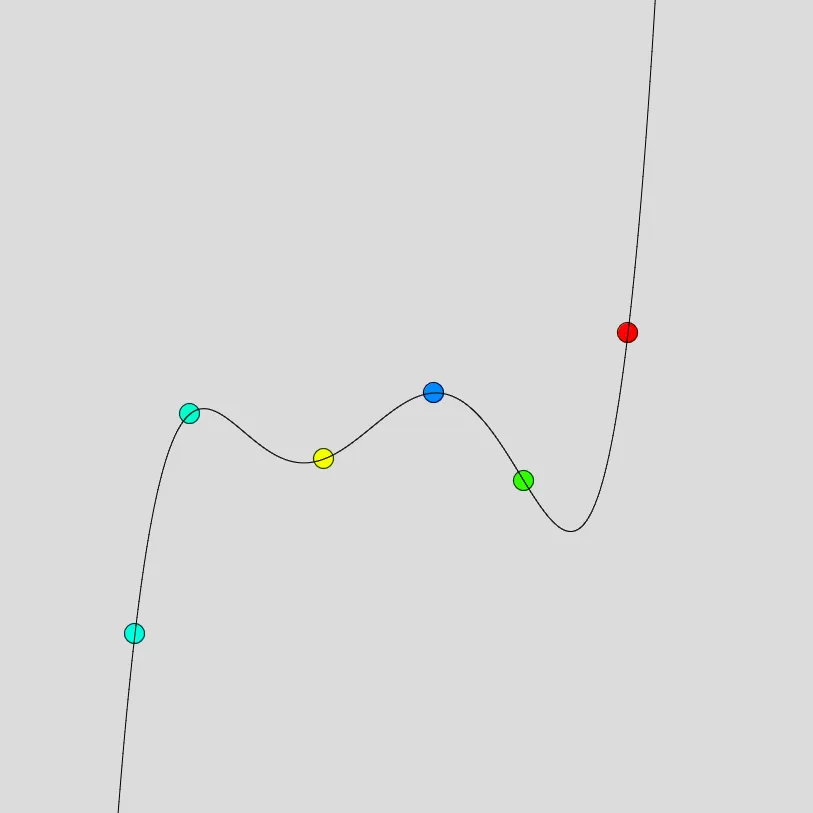
Interactive Demo
Lagrange interpolation, named after Joseph-Louis Lagrange, finds the unique polynomial of degree at most n − 1 through n points with distinct x-coordinates. I built this demo to show how the curve changes as you add and move points.
Open the full-screen interpolation demo.
Tap to add a point. Drag a point to move it. Keep the points at distinct x-coordinates so the polynomial is defined.
Secret Sharing
Shamir's Secret Sharing divides a secret into n shares, with a threshold t. Any t distinct valid shares can reconstruct the secret; no particular combination is required.
The demo above uses real-number coordinates to illustrate interpolation. It is not a cryptographic implementation. Shamir's scheme, introduced by Adi Shamir, needs finite-field arithmetic and securely generated random coefficients.
How It Works
- Choose the field and threshold: Use a finite field large enough to represent the secret and provide
ndistinct non-zero x-coordinates. Choose a thresholdtbetween 1 andn. - Create the polynomial: Encode the secret
sas a field element. Chooset − 1coefficients independently and uniformly at random from the field, using a cryptographically secure random source. Withsas the constant term, these form a polynomial of degree at mostt − 1. - Create the shares: Evaluate the polynomial at each chosen x-coordinate. Each share is a pair containing the x-coordinate and its corresponding value.
- Recover the secret: Use Lagrange interpolation in the same finite field with any
tdistinct valid shares. Evaluate the recovered polynomial at zero to obtains.
With this construction, fewer than t shares reveal no additional information about the secret. Using ordinary real-number arithmetic or predictable coefficients does not provide that guarantee.
Applications
One use is master-key recovery, as explored in my password manager project. Shares can be held by different people or stored separately, with a threshold needed to recover the key.
Educational Video
This video explains the connection between interpolation and secret sharing: